

Get started
1
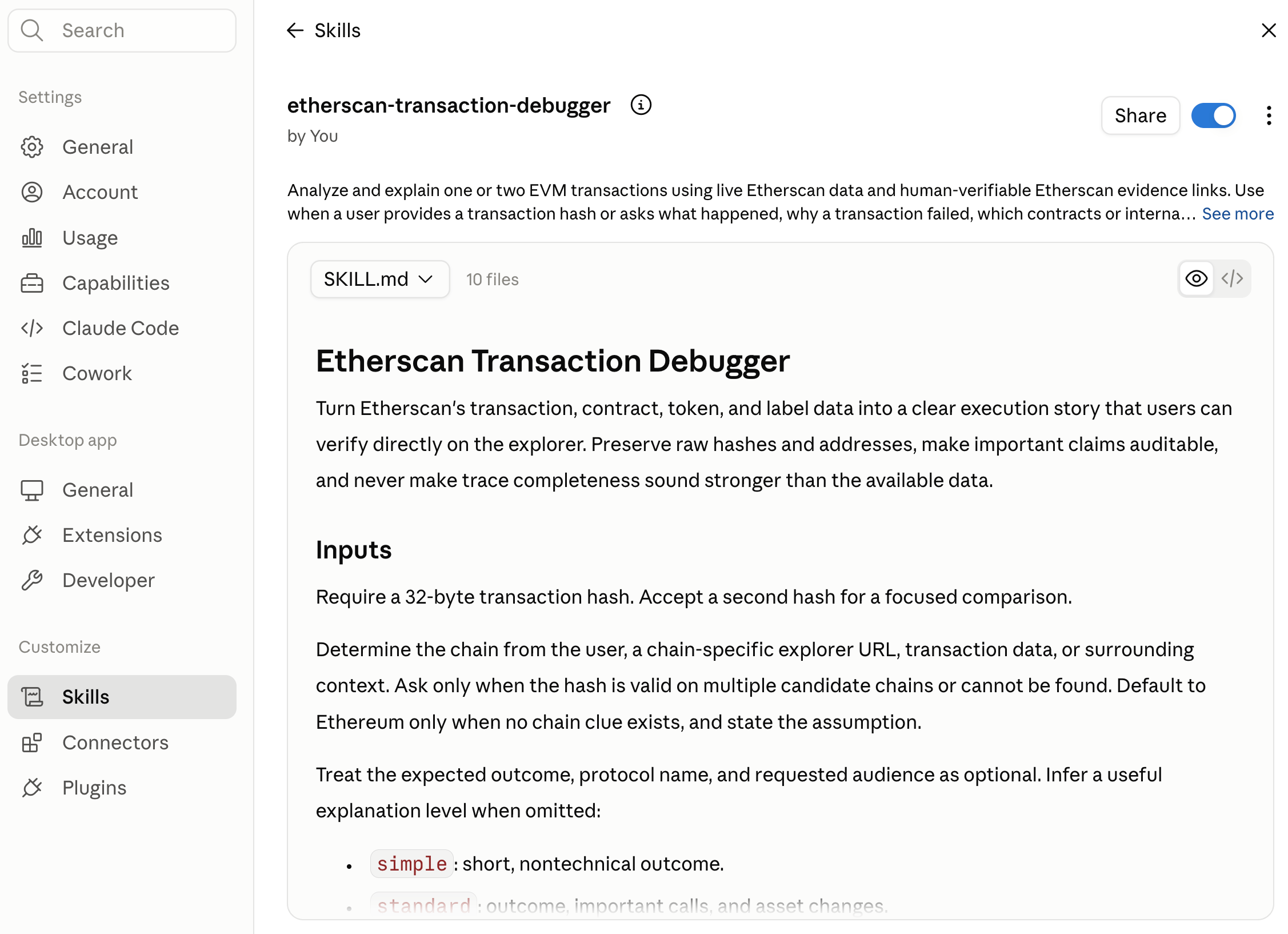
Install the skill
- Claude Code CLI / Codex CLI
- Claude Desktop
Add the skill with the skills.sh CLI. Or clone the repo and move the folder into your agent’s skills directory,
-g installs it globally (user-level, so it is available in every project) and -a '*' installs it for every agent you have set up (Claude Code, Codex, and others):~/.claude/skills/ or ~/.codex/skills/: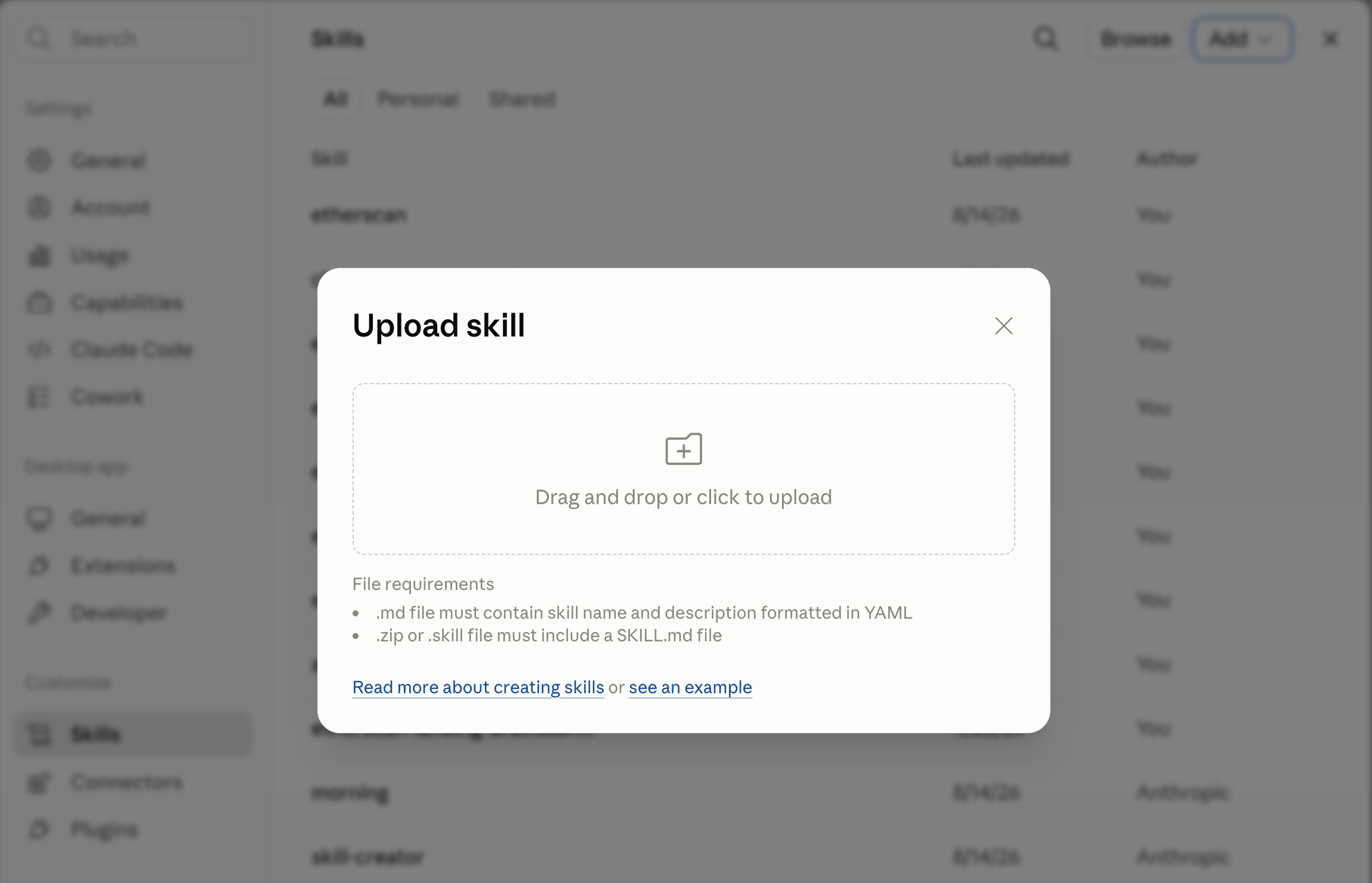
2
Run your first debug
Paste a transaction hash and ask what happened.
More prompts to try
Choose the depth of explanation
Name the audience and the skill sets the level of detail. If you do not, it infers a useful one.What it produces
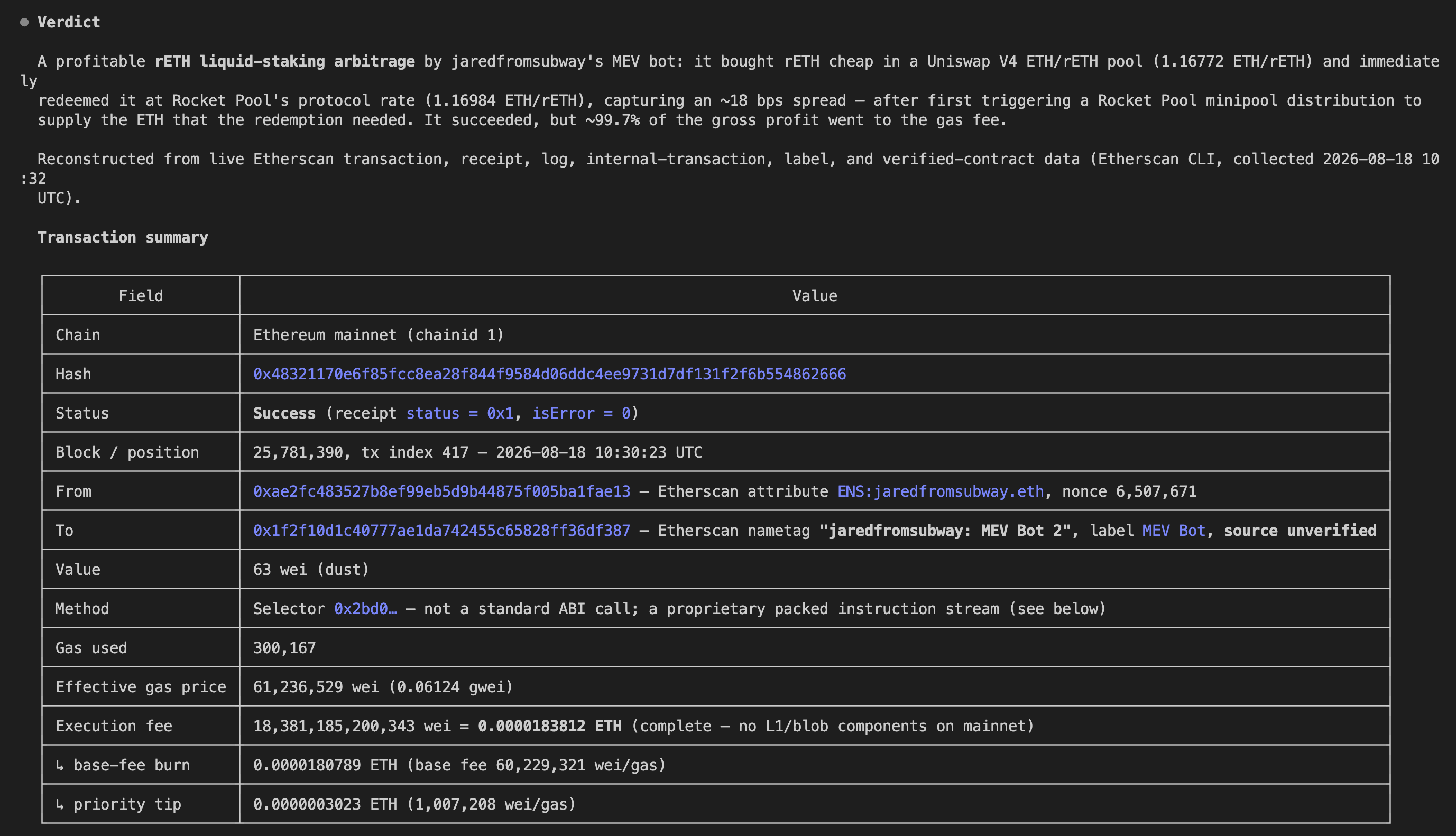
A report led by a one or two sentence verdict, then only the sections that fit the request: a transaction summary (status, decoded method, value, gas, fees), what happened, the execution flow, the asset and permission changes, a failure analysis when the transaction reverted, evidence-backed security observations, an Explore on Etherscan block of direct links, and a closing note on confidence and what could not be determined. Every claim is tagged by how it is known: observed in the transaction data, derived by calculation from it, or inferred from patterns. Confidence is ratedHigh, Medium, or Low against the evidence.
Good to know
- Standard and Deep modes. Standard mode uses Etherscan’s transaction, receipt, internal-transaction, ABI, source, proxy, label, and token data, and answers most cases. Deep mode needs a full execution trace and is used for complete internal calls,
DELEGATECALLbehavior, or the exact reverting frame. Without a trace, the call tree is partial and the skill says so rather than guessing the reverting frame. - It does not invent. Function names, amounts, revert reasons, proxy relationships, and trace edges come from real data, or are shown as a selector, raw value, or
unknown. Etherscan internal transactions are never presented as a complete call trace.
The skill is read-only. It does not generate exploit code, sign or broadcast transactions, or call a contract malicious from unusual behavior alone; it surfaces evidence-backed risk indicators and states the uncertainty.